
Medical Billing Comparison Guides, Resources and White Papers

The Complete Guide to Medical Billing for Local Pharmacies
Local pharmacies are expanding into clinical care, from immunizations to medication therapy management, but getting paid for those services depends on medical billing, which works very differently from prescription billing. This EnlivenHealth guide explains the trends driving the need for billing optimization, including the evolving pharmacist role, provider status granted during the pandemic, and shrinking prescription margins. It breaks down common obstacles such as limited staff experience, claim denials caused by errors, manual claim tracking and billing systems that cannot scale. You will also find a before, during and after roadmap for an optimization project, a worked vaccine ROI example set against software costs of $35 to more than $300 per month, and six capabilities to look for in a medical billing software provider.
The Complete Guide to Medical Billing Services
Is your practice better off keeping medical billing in-house or handing it to a revenue cycle management company? This guide from Advanced Data Systems compares both approaches. It explains when in-house billing makes sense for smaller practices and why larger groups may benefit from a full-service RCM partner that actually manages the revenue cycle, not just submits claims. It outlines what a solid RCM company should provide, from first-pass clearinghouse claim success and denial management to eligibility checks, patient statements and 24x7 data access. You also get four must-have evaluation criteria covering software ownership, specialty expertise, technology and transparency. A closing set of do's and don'ts addresses data ownership, exit costs and fees based on amounts collected rather than billed.
Medical Billing Software Market Overview
Medical billing software now underpins how hospitals, clinics and healthcare centers submit claims, follow up on them and collect payment. This MedicoReach market overview brings together growth forecasts, including an expected CAGR of 6.5% from 2017 to 2023 and 5.1% from 2020 to 2027. It also covers the demand drivers behind that growth, from rising healthcare expenditure and digitization to growing patient volumes. It outlines core benefits such as fewer billing errors, higher productivity and compliance assistance. It explains how the market is segmented by type, deployment and application, and notes why North America holds the largest share. You will also find a list of notable vendors, including Kareo, Brightree, Meditab and CollaborateMD, plus the forecasting models and research methods behind the analysis. Use it to get a quick read on the market before evaluating solutions.
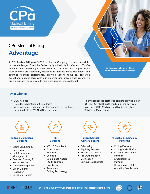
CPa Medical Billing Advantage
This two-page overview from CPa Medical Billing (A GeBBS Healthcare Company) explains how its revenue cycle management services are built for Federally Qualified Health Centers, community health centers and Tribal Health programs. It outlines four service areas: billing and collections, HIM, patient contact center support and AI-enabled technology platforms. These range from claim scrubbing and denial management to autonomous coding and reporting dashboards. It also covers the FQHC-specific expertise the team brings, including PPS, wrap payments, split billing, sliding scale, Title X and CHIP billing, along with supported specialties and systems such as EPIC, eClinicalWorks and NextGen. A customer story from North Shore Community Health describes collection efficiency rising from 70% to 98-99% within six months. Read it to judge whether outsourcing RCM fits your health center.
CareVoyant Medical Billing Software for Healthcare Providers and Billing Services Companies
This two-page brochure introduces CareVoyant's cloud-based Medical Billing Software, a billing and accounts receivable solution for home health care agencies, outpatient therapy clinics, behavioral health clinics, drug and alcohol treatment centers and billing service companies. It covers features across intake and admission, service authorization and plan of care, billing and AR, reporting and dashboards, and the CV Message Center. See how a single patient record spans multiple lines of service, how real-time or batch eligibility verification using ANSI 270/271 formats and an integrated claims scrubber help you send clean claims, and how UB04 and 1500 claims, secondary claims, private pay statements and collections are managed in one system. If you are evaluating billing software for complex, multi-service operations, it gives you a concise view of the capabilities to compare.