
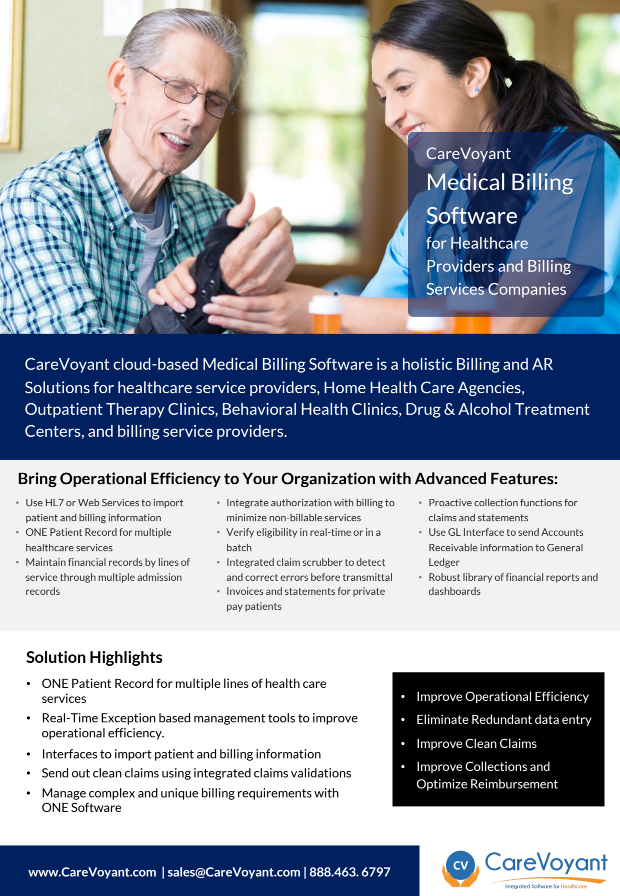

If you manage billing for a home health agency, a therapy clinic or a behavioral health program, the claim itself is rarely the hard part. The trouble starts upstream: patient details typed in twice, an authorization that lapses before anyone notices, eligibility checked after the visit, and payers who each want something different. CareVoyant's product overview shows how its cloud-based medical billing software connects those steps so claims go out clean and collections keep moving.
The overview is written for healthcare service providers and the billing services companies that work on their behalf. CareVoyant names Home Health Care Agencies, Outpatient Therapy Clinics, Behavioral Health Clinics and Drug & Alcohol Treatment Centers among the organizations it serves. If your team bills for several kinds of care under one roof, or for several clients at once, the problems it describes will sound familiar.
Medical billing software for organizations with more than one line of service
Most billing tools assume a patient receives one kind of care. Many agencies don't work that way. A single patient might receive home health visits, therapy and private duty services, sometimes during overlapping admissions. CareVoyant's answer is one patient record that holds every line of service, with financial records kept separately for each admission.
The overview explains what that structure means in practice. You'll see how historical and concurrent admissions are tracked, how patient and billing data can come in from other systems through HL7 or Web Services instead of being re-keyed, and how documents can be scanned and attached to the patient file. For anyone tired of reconciling the same patient across separate systems, this section alone makes the case for reading on.
Claims scrubber, eligibility verification and authorizations in one workflow
Denials and unbillable visits usually trace back to something that could have been caught earlier. The brief shows where CareVoyant places those checks. Eligibility verification runs in real time or in batch mode using ANSI 270/271 formats. Authorization records link directly to billing, so authorization numbers attach to claims and expiring authorizations surface before they turn into lost revenue. An integrated claims scrubber flags and corrects errors before anything is transmitted.
It also covers the payer mix many home and community providers deal with every day. You'll read how the software handles Medicaid, commercial insurance, managed care companies and county waiver programs, and how it manages UB04 and 1500 requirements (paper and electronic) together rather than in separate processes.
After reading, you'll have a clearer picture of:
- Where redundant data entry can be removed from intake through billing
- How authorization and eligibility checks fit into the claim cycle
- What tools exist for private pay statements and proactive collections
- How accounts receivable data reaches your general ledger
Healthcare accounts receivable software that follows the money after the claim
Submitting a clean claim is half the job. The overview also walks through what happens next, at a high level. Secondary claims can be generated automatically, insurance payments can be imported electronically, and a Collections Manager organizes follow-up on both claims and patient accounts. A GL interface sends receivables information to your general ledger, which matters if finance and billing currently live in different worlds.
Reporting gets its own attention. CareVoyant describes a library of clinical, financial, scheduling and census reports that can be assigned by user or role and scheduled for delivery to office and field staff. There's also a HIPAA compliant message center that pulls alerts and internal communications into one place.
The document is produced by CareVoyant itself, so treat it as a clear account of what the product is designed to do. It includes feedback from a finance team member at a home care agency offering multiple home-based services, who values having data entry, notes, claims and transactions in the same program and being able to work with CareVoyant to adjust functions that weren't fitting their needs. The brief also points to user reviews and recognition on G2.
Get the CareVoyant medical billing overview
If you're comparing home health billing software or looking for a better way to handle behavioral health billing across service lines, this short overview is a fast way to see whether CareVoyant fits. Download it to get the complete feature breakdown for intake, authorizations, billing, accounts receivable, reporting and messaging, along with the customer perspective and contact details for the CareVoyant sales team.