
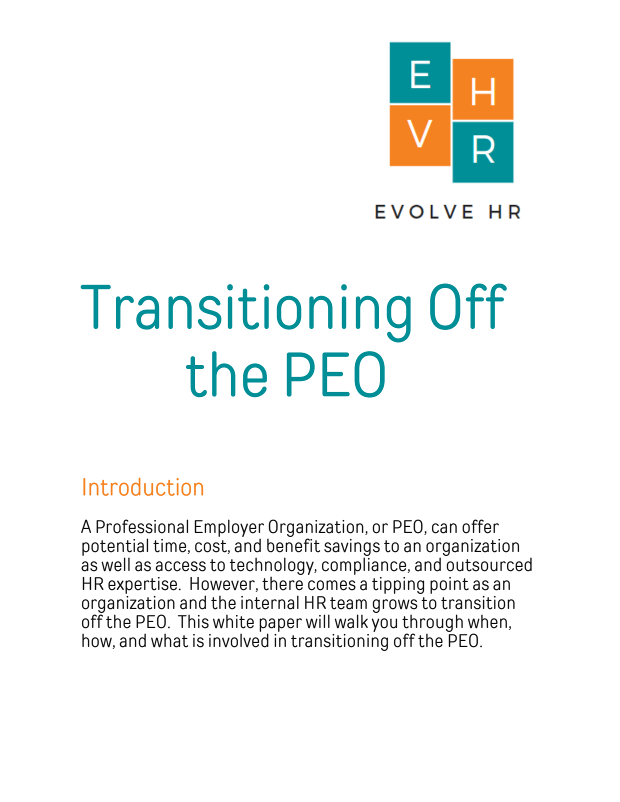

A PEO earns its place when you're small. It runs payroll, opens the door to benefits and a 401k you might not offer on your own, and keeps compliance off a lean team's plate. Growth changes that math. At some point your HR team spends more energy working around the PEO's processes than getting value from them, and you want direct control over benefits and the employee experience. When you reach that point, leaving a PEO moves from idea to plan, and the hard questions are about timing and everything you'll need to run yourself afterward.
Transitioning Off the PEO is a concise white paper from Evolve HR for leaders and HR teams at growing organizations who suspect they've hit that tipping point. It answers three practical questions: when to make the move, how to run the transition, and what work lands on your side of the table once the PEO steps away.
Signs your company has outgrown its PEO
There's no single trigger, and the paper is clear that the right moment depends on several factors. It lays out the signals that tend to show up when a company is ready, touching on headcount, growth plans (including growth through acquisitions), and how your HR team experiences the PEO day to day.
You can hold your own situation up against those signals and judge whether the timing fits now or a little further out. That's useful before you raise the topic with leadership or start talking to vendors.
A practical plan for leaving a PEO and bringing HR in-house
Deciding to go is the easy part. The paper sets out a six-step approach to the transition itself, starting with timing (contract requirements and benefit renewals both shape when you can realistically move) and finishing with how you prepare employees for the change.
Between those points sits the work many teams underestimate. You'll see why it pays to bring stakeholders into the conversation early, to pin down the real pain points with your current PEO, and to think through how the change will affect employees and the business before anything is switched over.
A central idea is defining your own HR service delivery model: deciding who will handle what once the PEO is gone, so every area has an owner. The authors also make a point that's easy to miss under deadline pressure. Most of the effort goes into executing the "what," but the "how" deserves real attention too.
What you'll set up yourself: HRIS, benefits, compliance and workers' comp
When the PEO stops doing these jobs, someone has to pick them up. The paper outlines six areas you'll need to cover with new partners, tools or internal ownership. They include HRIS selection (with a simple way to compare options against your requirements), state unemployment tax reporting, and workers' compensation setup, along with benefits, retirement plan and compliance considerations.
Each area comes with a short, practical prompt on what to decide or who to bring in, so you can start building your list of partners and questions. After reading, you'll be able to:
- Judge whether your organization is ready to transition off its PEO
- Sequence the move around contracts, renewals and other business activity
- Identify which functions need a new owner, partner or system
- Plan how to communicate the change and train employees on new processes
Written by HR leaders who have scaled HR operations
The paper comes from the Evolve HR team. Jill Lehman, Founder and Client CHRO, has a 25-year HR career that includes VP HR and CHRO roles at global public companies and private equity-backed scale-ups, with deep experience in scaling HR operations, M&A and integration. Jill Mullens, Senior Consultant, brings more than twenty years of HR experience, and her specialty is designing and scaling HR service delivery models and programs. That background shows in the advice. It's practical and focused on what a growing HR team actually has to do.
Download your PEO exit plan starting point
If you're weighing whether to leave your PEO, or you've decided and need a clear place to start, download the full white paper. You'll get the readiness signals, the six-step transition approach, the breakdown of the six setup areas from HRIS to workers' comp, and the authors' closing takeaways for a smooth handoff. It's a quick read you can share with your leadership team before the next renewal decision.