
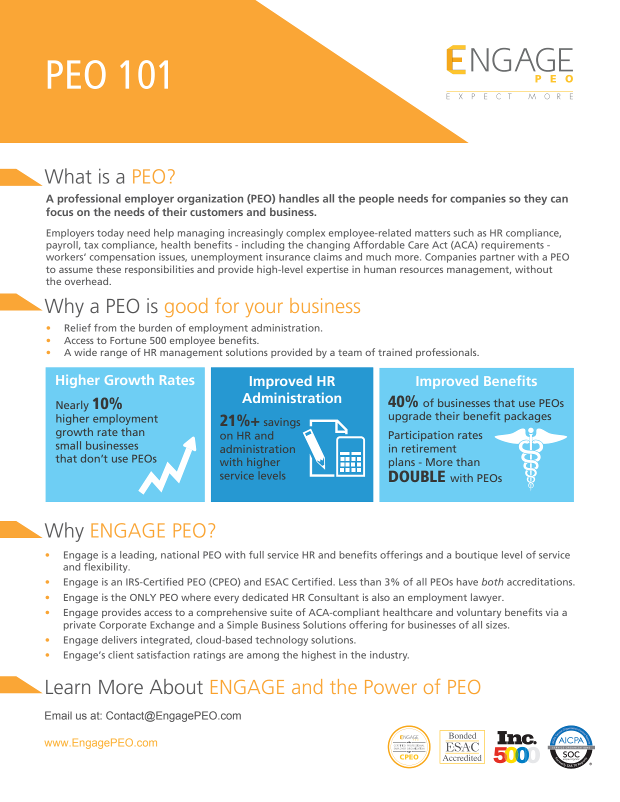

If you run a small or mid-size company, payroll runs, tax filings, benefits enrollment and compliance questions probably eat more of your week than you'd like. A full HR department isn't realistic yet, but handling everything yourself carries real risk. That's usually when owners start asking what is a PEO, and whether handing employment administration to one actually makes sense.
PEO 101 is a short primer from Engage PEO that answers that question in plain terms. It explains how a professional employer organization takes over the people side of running a company, what you hand off, what you keep, and what to check before you sign.
What is a PEO, and how does co-employment work?
The idea at the center of every PEO relationship is co-employment. Your company and the PEO share employer responsibilities, and a written client service agreement spells out who handles what. The document shows how that split typically falls: which tasks move to the PEO, such as remitting wages and employment taxes, and which stay with you, including day-to-day operations, sales and worksite safety.
It also covers how states and the IRS recognize PEOs as employers. That's useful context if you're wondering whether the arrangement is legally sound or just a workaround.
Then there's the worry that stops many owners cold: will I lose control of my business? The FAQ answers that directly and explains where the lines are drawn between your role and the PEO's.
PEO vs employee leasing and temporary staffing
"PEO" still gets confused with employee leasing, partly because some older state laws use leasing language for what are really PEO relationships. The document separates the three models clearly. You'll understand how a PEO differs from a leasing company or a temp staffing service, who the workers belong to in each case, and what happens to your existing team if a PEO relationship ends.
If you've been hesitant because you didn't want an outside firm "owning" your employees, this section is likely to change how you see the option.
PEO benefits for business owners and their employees
Cost and benefits are usually what make or break the business case for HR outsourcing. PEO 101 explains how a PEO's economy of scale can lower employment costs, reduce hiring overhead and give a small company's staff access to the kind of benefits normally associated with large employers, from retirement plans to health, dental and life coverage.
It also pulls together industry figures on employment growth, HR savings, benefit upgrades and retirement plan participation among businesses that use PEOs. Those numbers are handy if you need to justify the move to a partner, a CFO or yourself.
The employee side gets attention too. You'll see why access to better benefits, professional HR support and clearer communication tends to matter for retention and morale.
How to vet a certified PEO before you commit
Picking a provider is a financial decision as much as an HR one, since the PEO will be handling your payroll taxes and benefit plans. The FAQ explains why audited financial statements matter, why most PEOs don't publish their financials, and what kind of due diligence a careful buyer should do. It also touches on licensing, both for the PEO itself and for the insurance benefits it offers.
Inside the PDF you'll find:
- A plain-English explanation of what a PEO does and who uses one, from small professional practices to companies with their own HR teams
- Fourteen frequently asked questions answered with material sourced from the National Association of PEOs (NAPEO)
- An overview of Engage PEO's approach and credentials, including IRS certification as a CPEO and ESAC accreditation
The mix is what makes it practical. The FAQ portion draws on the industry's trade association, so you get a neutral grounding in how PEOs work, while the opening pages show how one national provider structures its HR, benefits and technology services.
Download PEO 101 to get the full FAQ, the industry figures on growth, savings and benefits, and a clear picture of how co-employment would work for your company. It's a quick read that will help you decide whether a PEO belongs on your shortlist and what to ask when you start talking to providers.