

If you run finance or operations at a small or mid-sized business, the ERP shortlist often comes down to two cloud-native names. Compare Acumatica vs NetSuite on a feature grid and you'll find a lot of overlap: financials, CRM, project accounting, inventory, manufacturing, distribution and commerce. That makes the decision harder, not easier. When the modules match, the real differences show up later, in how the system gets implemented, what it costs at renewal, and how the vendor treats you once the contract is signed.
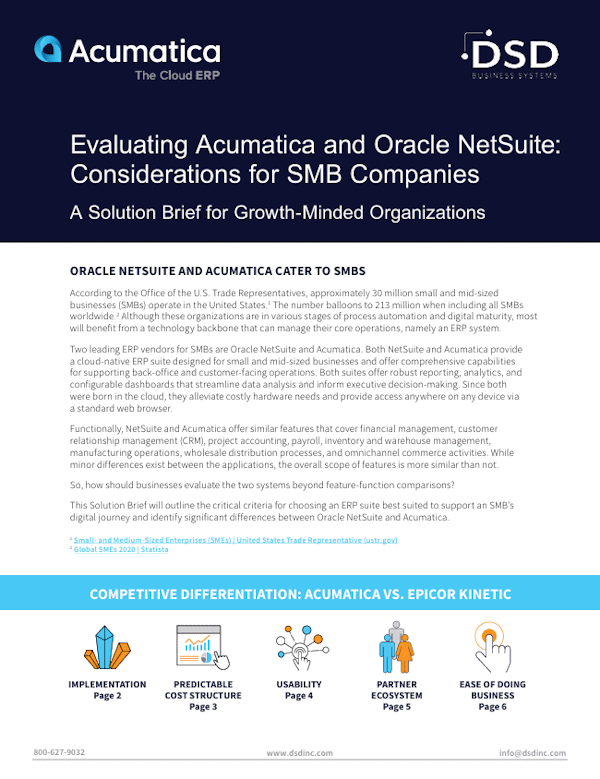
Evaluating Acumatica and Oracle NetSuite: Considerations for SMB Companies is a solution brief from Acumatica and DSD Business Systems, written for growth-minded SMBs at exactly this stage. It sets the feature checklist aside and asks a more useful question: what should you evaluate once both products can technically do the job?
An Acumatica vs NetSuite comparison that goes beyond features
The brief is organized around five differentiators that matter to buyers of SMB ERP software, especially teams with limited IT staff and little room for budget surprises. Each one is framed as a risk you can check for during selection rather than discover after go-live.
- Implementation and risk: how each vendor scopes a deployment and what a heavily discounted rollout may leave out.
- Cost predictability: licensing models, user counts, transaction volumes and what happens at renewal.
- Usability: day-to-day ease of use, reporting, and what it takes to customize the system.
- Partner ecosystem: how resellers, add-on software and support are structured.
- Ease of doing business: the working relationship with the vendor over the life of the contract.
Where ERP implementation risk and NetSuite pricing surprises come from
Two sections stand out for anyone building a business case. The first looks at deployment risk: why a fast, fixed-scope rollout can look attractive in the proposal and still fall short of what the business needs to run properly. You'll see the two vendors' accelerated deployment approaches, NetSuite's SuiteSuccess and Acumatica's FastTrack, contrasted on scope, discovery and planning, along with what you should get in writing before a project starts.
The second covers NetSuite pricing and total cost of ownership. It explains how per-user licensing and transaction-based Service Tiers work, and includes a reference table of those tiers as of July 2022. It also addresses renewal terms and contract length, the details that tend to get overlooked while everyone is focused on the first-year discount. Acumatica's consumption-based model sits alongside it, so you can see how the two approaches differ when you add part-time, seasonal or external users.
Usability, partners and vendor relationships in cloud ERP solutions
The remaining sections move from contracts to daily life with the software. The usability comparison looks at workflow configuration, reporting, collaboration tools and the programming skills each platform expects for customization. That last point affects how much you'll depend on outside help, and what that help costs.
The partner section examines how each vendor sells and supports its product through resellers. It's a topic many buyers skip. It shouldn't be, because the health of that channel shapes the service you receive years after purchase.
Throughout, the brief draws on G2 reviews, analyst ratings, press coverage and quotes from customers including Boulder Creek Stone, Premier 1 Supplies and Shoebacca. A closing section speaks directly to small and mid-sized manufacturers who also distribute and sell across multiple channels.
Questions to settle before you sign a cloud ERP contract
By the end, you'll have a sharper set of questions for vendor demos and contract talks. What's actually in scope? How do costs scale as headcount and transaction volume grow? How hard will changes be in year three? And who supports you when something breaks? Those answers matter whether NetSuite, Acumatica or both are on your list.
Download the full solution brief to get the five-part comparison, the NetSuite Service Tier reference table, guidance on what to confirm before an implementation begins, and the customer and reviewer perspectives behind each point.