

What a professional services ERP should cover for project-based firms
Firms that sell expertise and time live or die by project margins. Yet many still run those projects across disconnected tools: a timesheet app, a separate billing process, a spreadsheet for staffing, and an accounting system that only shows profit or loss after the work is done. When a job drifts over budget, the warning often arrives too late to act on. If you are evaluating a professional services ERP to close those gaps, this overview of Acumatica Professional Services Edition shows how a single cloud platform connects estimating, delivery, billing and financials.
The document is written for owners, operations leaders, controllers and project managers at services firms that have outgrown entry-level accounting software or an aging on-premises system. It frames the decision around a familiar problem: traditional ERP platforms were not built for the way project-based businesses actually work, with field and office teams in different places, scopes that change midstream, and clients who expect quick answers.
Project accounting, billing and resource management in one system
The core of the brochure is a map of what the Professional Services Edition does and how its parts connect. Rather than treating project accounting software and resource management software as separate purchases, it shows them as one project-centric ERP where data entered in one place flows into the rest.
After reading it, you will understand how the platform handles:
- Project management, with budgets compared against actual costs, commitments and schedules
- Flexible billing, including milestone, fixed-price and time and material arrangements
- Resource allocation of staff, equipment and technology by team, department and timeframe
- Time and expense management from any device, feeding directly into project accounting
- Embedded CRM for opportunities, proposals, contracts and renewals
- A client self-service portal for support cases
You will also see how change orders, revenue recognition, payroll and cash management fit into the same workflow. That matters if your current pain is reconciling numbers between systems before anyone can make a decision.
A good portion of the document covers the underlying cloud platform. It explains the open architecture and APIs, the low-code and no-code tools for adding capabilities, and how built-in AI and machine learning are used to automate routine work such as accounts payable processing. For firms that worry about getting locked into rigid software, this section helps you judge how far the system can be tailored without a large IT investment.
Who Acumatica Professional Services Edition is built for
The brochure names a wide range of service businesses it is designed to support. Architectural, engineering and surveying firms appear alongside technology services, safety and security providers, utilities, consulting and marketing agencies, and staffing, legal and accounting practices. If your work is organized around projects, contracts and billable resources, you will likely find your situation described.
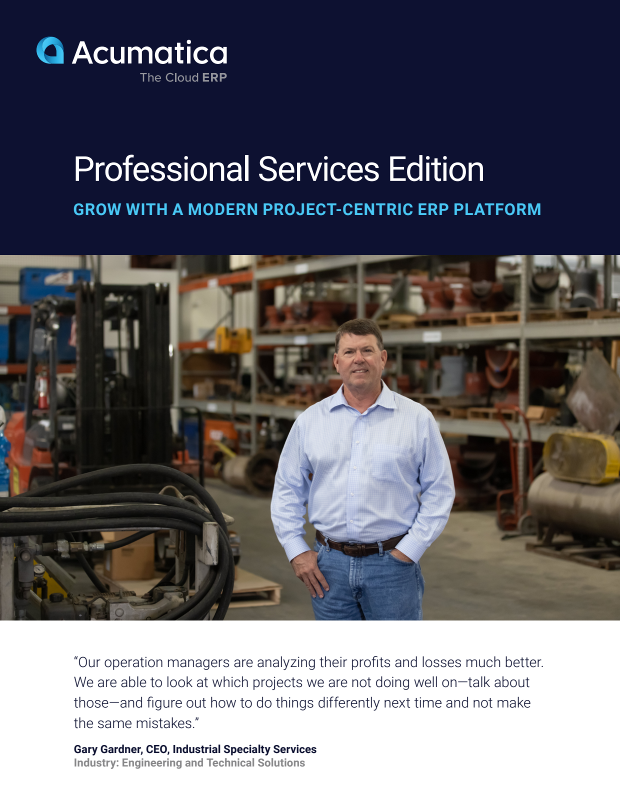
It also brings in the voices of customers from several of these industries, including an engineering services CEO, a security company controller and a software COO, who describe what changed after they adopted the system. Their comments focus on practical outcomes: better visibility into which projects are underperforming, a clearer view of the sales pipeline, and a platform that keeps pace as the business grows.
For anyone building a business case, two sections stand out. One outlines Acumatica's Customer Bill of Rights, which sets out its commitments on licensing, implementation fees, pricing increases and data access. The other summarizes the independent recognition Acumatica has received from analysts and user review platforms, along with a snapshot of the company by the numbers. Both give you material to bring to a finance team or leadership group that wants more than a feature list.
Produced by Acumatica, the document is a product overview rather than a neutral comparison, so its value lies in showing you exactly what the edition includes and how the pieces work together. That makes it a practical reference when you are shortlisting cloud ERP for professional services and need to check whether a vendor covers your full project lifecycle, from first proposal to final invoice.
Download the full Acumatica Professional Services Edition brochure to get the complete feature breakdown across planning, projects, financials, services and resource management, the list of industries it supports, customer perspectives from real firms, and the details of the Customer Bill of Rights. It is a quick read that will help you decide whether this platform belongs on your shortlist.