

Choosing finance software when every tool has to earn its place
Most finance teams don't build their stack from a blank page. Budgets are fixed, the ERP you pick now may follow you for years, and every vendor demo starts to sound the same. Choosing finance software becomes a balancing act between cost, functionality, ease of use, integrations and how well a tool will scale as the company grows. Vendor websites won't tell you which trade-offs matter once the contract is signed. Your peers can.
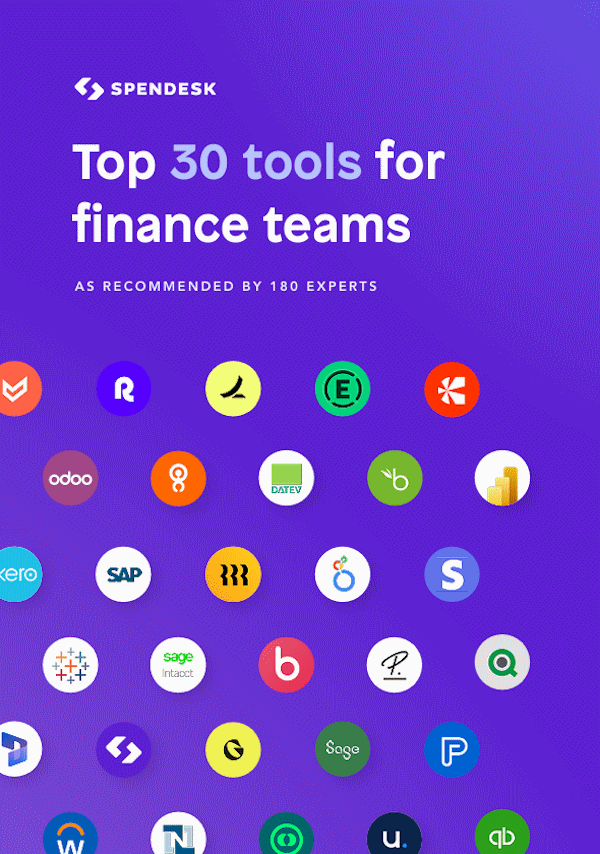
Top 30 Tools for Finance Teams collects those peer opinions in one place. It's written for CFOs, finance directors, controllers and the people who run daily finance operations. It is especially useful at SMBs and growing mid-market companies that are weighing their next platform or replacing one they've outgrown.
What finance leaders actually use across the finance tech stack
The guide covers 30 tools, grouped into six categories that map to the real jobs a finance team has to get done:
- Cloud accounting software for bookkeeping and closing the books
- ERP platforms for companies outgrowing standalone accounting
- Spend management tools for cards, receipts, invoices and approvals
- Billing software and accounts receivable tools for getting paid on time
- Payroll software and HR tools that finance and HR have to share
- Business intelligence tools for turning raw data into usable reporting
For each tool you get a plain description of what it does, the features users value most, the type of company it suits best, and short, unattributed quotes from finance leaders explaining why they chose it. Some of those quotes are refreshingly candid about limits, such as the point at which a tool stops coping well with multiple entities. That kind of detail can keep a poor fit off your shortlist before you've sat through a single demo.
How to match finance tools to your company's size and complexity
The fit guidance is where the guide earns its keep. You'll see which platforms finance leaders view as a natural first ERP for SMBs moving off simple accounting, and which are built for larger companies with increasingly complex needs. You'll also learn which tools lean toward European or US companies, which work best if your business already runs on Microsoft products, and which are favoured by SaaS businesses, e-commerce brands or B2B companies with long payment cycles.
Each category opens with a short explainer of what that type of tool does and when a company tends to need it. That's handy when you have to brief a CEO or board on why a new line item belongs in next year's budget, or when you're building a business case for consolidating tools.
Beyond the main picks, there's a set of honourable mentions that drew enough votes to deserve a look. There's also a chapter on how finance teams are really using AI today: where it already shows up inside familiar tools, what people use general AI assistants for, and how far adoption still has to go before it touches core finance processes.
Peer-rated rankings from the CFO Connect community
The rankings come from an anonymous survey of finance leaders in the CFO Connect community, whose members are concentrated in Western Europe, the UK and the US. The guide was produced by Spendesk together with CFO Connect, a global community and resource hub for modern finance leaders.
The result reads less like a feature comparison and more like advice from colleagues. These are recommendations from people who run month-end closes, consolidations, collections and payroll, explained in their own words. You can see where opinion is close to unanimous and where the field is more open, which tells you as much about a category as any spec sheet.
Download Top 30 Tools for Finance Teams to see the full rankings in every category, the best-fit profiles and user quotes for all 30 tools, the honourable mentions and the findings on AI in finance. Use it to build a shortlist, pressure-test a vendor pitch, or back up your next platform decision with evidence from finance leaders who have already made the same choice.