
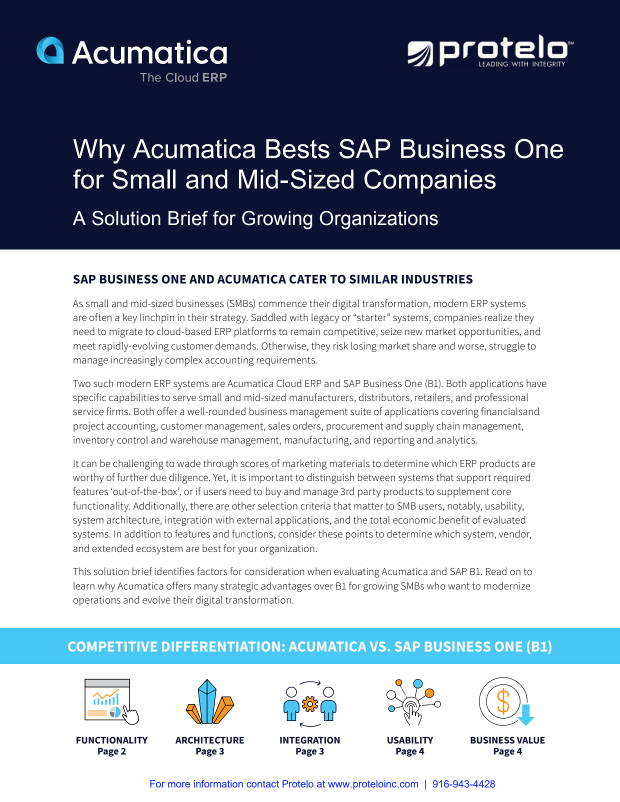

Most growing companies don't replace their ERP because they want to. They replace it because the starter system has stopped keeping up. Accounting gets more complex, new locations or sales channels need support, and workarounds pile up in spreadsheets. If your shortlist has come down to Acumatica vs SAP Business One, you're comparing two products that target the same kinds of businesses and look similar on paper. The differences show up later, in licensing bills, integration projects and how willing your team is to actually use the system.
This solution brief is written for owners, finance leaders and operations managers at small and mid-sized manufacturers, distributors, retailers and professional service firms who need to make that call with confidence. It is a competitive comparison that makes the case for Acumatica, presented by Acumatica and its partner Protelo. It gives you a clear set of criteria for testing both vendors.
Acumatica vs SAP Business One: where the differences actually show up
Vendor marketing tends to blur together. The brief cuts through it by asking a practical question: which capabilities come in the core product, and which would you have to buy from third parties and keep connected yourself? Every add-on means another cost, another contract and another thing that can break during an upgrade.
One of the most tangible parts is a side-by-side feature table covering eight capability areas, including payroll, multi-warehouse management, field service, eCommerce connectors and multi-company support. It's a quick way to spot gaps that would otherwise surface halfway through implementation.
Beyond features, the brief looks at the less obvious factors that shape long-term success in SMB ERP selection:
- System architecture: how a cloud-native ERP compares with older client-server software that was later adapted to run over the internet, and what that means for scalability, customization and pace of innovation
- Integration: how each platform connects to the other applications you rely on, and what ongoing maintenance involves
- Usability: how the interface affects training time, adoption and whether people drift back to spreadsheets
- Business value: how licensing and implementation models behave as your headcount grows
Understanding SAP Business One limitations before you commit
If you're already running SAP B1, or a reseller has put it in front of you, the brief helps you ask sharper questions. It explains where B1's capabilities are thin rather than absent, in areas such as project management, manufacturing and mobile access, and why those distinctions matter for companies that plan to grow. It also covers how B1's per-user licensing and module packaging work, so you can think through what your costs might look like as your team expands.
For teams looking for an SAP B1 alternative, the counterpoint is detailed too. You'll read how Acumatica approaches user access, reporting, APIs and pricing commitments, including its published Customer Bill of Rights covering price increases and hidden fees. Peer review sites and customer win-loss feedback are referenced along the way, so you have outside perspectives to weigh alongside the vendor's own claims.
A short, focused brief for your ERP evaluation
At five pages, it's a quick read you can circulate to your selection committee before vendor demos. Each section is built around one decision criterion, which makes it easy to turn into questions for your own due diligence. That's the real value here. Instead of reacting to whichever demo was most polished, you walk in knowing what to probe.
It closes with a short customer perspective from a company president describing what it's like to run the business inside a single system, plus a summary you can use as a checklist when comparing finalists.
Download the full solution brief to get the feature comparison table, the five-part breakdown of how Acumatica and SAP Business One differ on functionality, architecture, integration, usability and business value, and a set of evaluation criteria you can bring into your next vendor conversation.