
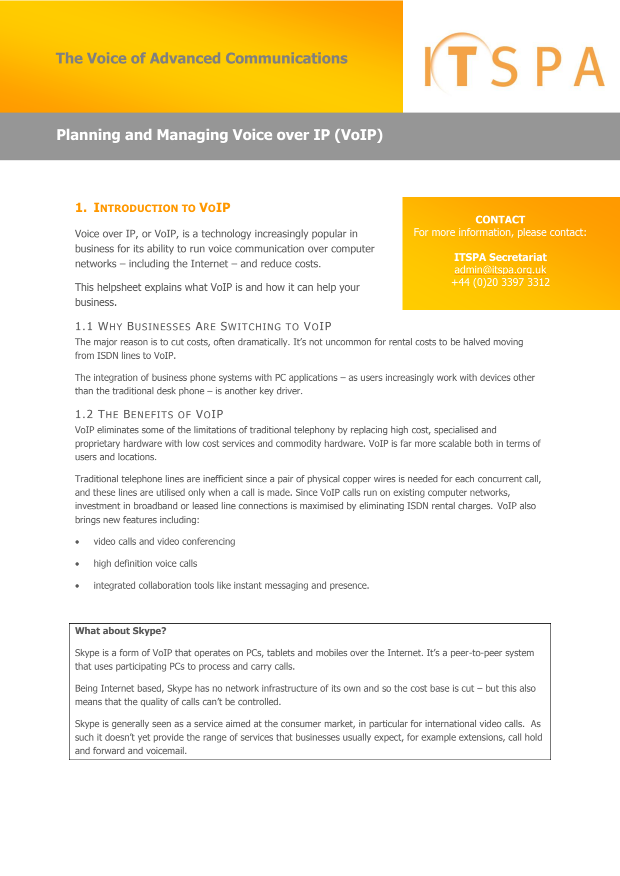

If your business still pays rental on ISDN lines, you already know how much a traditional phone system costs to keep running. Many UK firms are now looking at business VoIP to bring that bill down and to connect their phones with the PCs, laptops and mobiles their staff actually use. The harder part is knowing what the switch involves: which costs disappear, which new ones appear, and whether your network can carry the calls without hurting quality.
Planning and Managing Voice over IP (VoIP) is a practical helpsheet from the ITSPA Secretariat, the team behind the Internet Telephony Services Providers' Association, the UK trade body for VoIP providers. It is written for business owners, office managers and IT leads who need to plan a move away from ISDN and want plain answers before they speak to suppliers.
What switching to business VoIP costs and saves
The most useful starting point for a business case is a pair of tables that set out the money on both sides. One covers what you will pay for, from handsets and installation to licences, call charges, connectivity, SIP trunks and PBX services, with each item marked as one-off or recurring. The other covers where savings come from, including line rental, calls between branches, avoided hardware and maintenance, and the harder-to-price value of home working and flexibility.
You will come away able to separate the costs that depend on your choice of system from the ones that depend on your existing network. That matters when supplier quotes arrive in very different shapes. The helpsheet also gives typical figures for several of these lines, so you can sanity-check a proposal rather than take it on trust.
Hosted PBX, SIP trunks and VoIP network requirements
Once the numbers make sense, the next question is how the system fits together. The document explains in plain language how a hosted PBX moves your phone system off site and into a provider's data centre, and why that lets staff work from any location as if they were sitting in the office. It covers how SIP trunks connect your system to the outside world and how they can replace a bank of ISDN lines with a single internet connection.
It also tackles the practical details that often get skipped in sales conversations:
- keeping your existing telephone numbers, even if you move office
- choosing between desk handsets and soft phones, and where to buy them
- why upload capacity, not download speed, limits how many calls you can run
- how codec choice trades audio quality against bandwidth
- why voice and data traffic may need to be separated on your network
Smaller firms get their own section. Sole practitioners and small teams will see how hosted services for their market handle extensions and features, and what kind of contract terms to expect.
VoIP security, disaster recovery and compliance
Moving your phones onto the internet raises fair questions about risk. The helpsheet explains how VoIP compares with traditional lines on call interception, why fraud protection should be part of your supplier checks, and what you need to know about emergency 999 calls during a power cut or internet outage.
On the upside, it shows how VoIP can cover the telephony side of business continuity almost by default, with calls redirected to another office or to staff at home if a site goes down. Regulated firms will find a short section on call recording for FSA compliance, and on why a centralised VoIP approach can change the cost picture for businesses with more than one location.
The document closes with a set of do's and don'ts drawn from the trade association's experience. One warns against splitting your phones, SIP trunks and broadband across different suppliers, a setup the authors compare to playing pass the parcel when something breaks. There are also pointers on testing a provider before you sign and on what ITSPA membership and its Quality Mark tell you about a supplier.
Download the VoIP planning guide
Get the full five-page helpsheet to see the complete cost and savings tables with typical figures, the network and bandwidth guidance, the security and emergency-call advice, and the full list of do's and don'ts. Fill in the form to download your copy and go into your next supplier conversation knowing exactly what to ask.