
Choosing Agile Program Management software when one team becomes many
A few high-performing Agile teams can carry a lot of weight. Then the organization asks for the same results across a whole program, and coordination starts to break down. Some teams run Scrum while others run Kanban. Sprint lengths don't match. Teams work in different delivery tools, or in the same tool configured three different ways. Dependencies show up late, and leaders can't see what's happening across teams without chasing status updates. Adding more Agile teams doesn't fix any of this. The right Agile Program Management software can, but only if you know what it needs to do before the vendor demos begin.
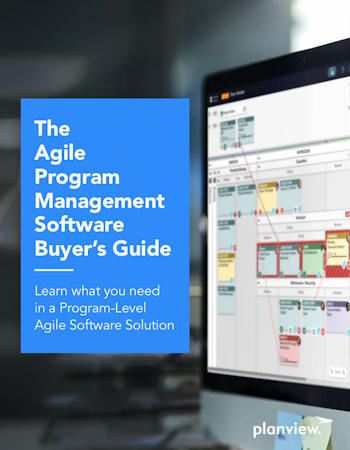
The Agile Program Management Software Buyer's Guide, produced by Planview, is written for Agile leaders who are moving from a handful of teams to a scaled Agile organization. It focuses on the team-of-teams level (the program or Agile Release Train), where product owners and leaders need to see progress at a glance and manage the trade-offs that come with delivering large initiatives.
What to look for in enterprise agile tools for scaled planning
The guide starts with the problems organizations run into as they scale. Legacy structures, mismatched cadences, mixed methodologies and funding practices that don't fit how Agile teams work all make cross-team delivery harder. It then turns those problems into a set of evaluation criteria for program-level tools.
Each criterion gets its own short section. You'll read why the capability matters at scale, which specific features to look for when you assess a product, and how Planview addresses that need in its own solution, with product screenshots. That pairing makes the criteria concrete. You can see what a capability looks like in practice instead of working from a vague feature name on a spec sheet.
After reading, you'll be better prepared to:
- Judge whether a tool connects strategic goals to the daily work of individual teams
- Assess agile capacity planning features that help teams avoid overcommitting
- Check whether a product supports the scaling framework you use, or a hybrid of several
- Test whether teams can keep their current delivery tools instead of being forced to switch
- Separate the capabilities you truly need from the ones that are only nice to have
Planning events, dependencies and portfolio visibility
A large part of program management happens in shared moments: quarterly or Program Increment planning, retrospectives, brainstorms. The guide looks at what software should do to support these sessions, whether your teams meet in the same room or join remotely. It also explains why the output of those conversations needs to flow straight into the work.
Dependencies and risk get careful attention as well. When dozens of teams depend on each other, one blocked item can quietly delay a release. You'll learn which kinds of visual signals and health indicators help surface bottlenecks early, so leaders can decide how to pivot and teams can adjust plans without losing sight of the bigger picture.
The guide also covers data. Real-time, reliable reporting is what lets every part of a release train understand how its work contributes to business results. It describes what to expect from dashboards and analytics at both the team and program level, including the ability to consolidate information from teams working in different tools.
A buyer's checklist and vendor comparison worksheet
Two practical tools close the guide. The first is a set of questions to ask yourself before you start vendor analysis, framed around where your organization stands in its Agile transformation. The second is a purchase worksheet that lets you compare up to three solutions side by side against the capabilities that matter most at the program level. It works well as a shared scorecard for an evaluation committee and as supporting material for an internal business case.
The guide closes with a short overview of Planview's Agile Program Management solution bundle for readers who want to see how one vendor packages these capabilities.
If you're responsible for scaling Agile and need a clear way to evaluate program-level tools, download the full buyer's guide. You'll get the complete criteria checklist with the specific capabilities to consider under each one, real product examples for every criterion, the self-assessment questions and the ready-to-use vendor comparison worksheet.