

Most construction firms didn't plan their software stack. It grew one problem at a time, with one app for drawings, another for safety forms and a spreadsheet for budgets, each with its own login. Field teams now re-enter the same data in several places, owners and contractors work in tools that don't talk to each other, and nobody can pull a clean report across projects. If you've been asked to fix that by choosing new construction management software, you're facing a big decision with real money, time and team habits riding on it.
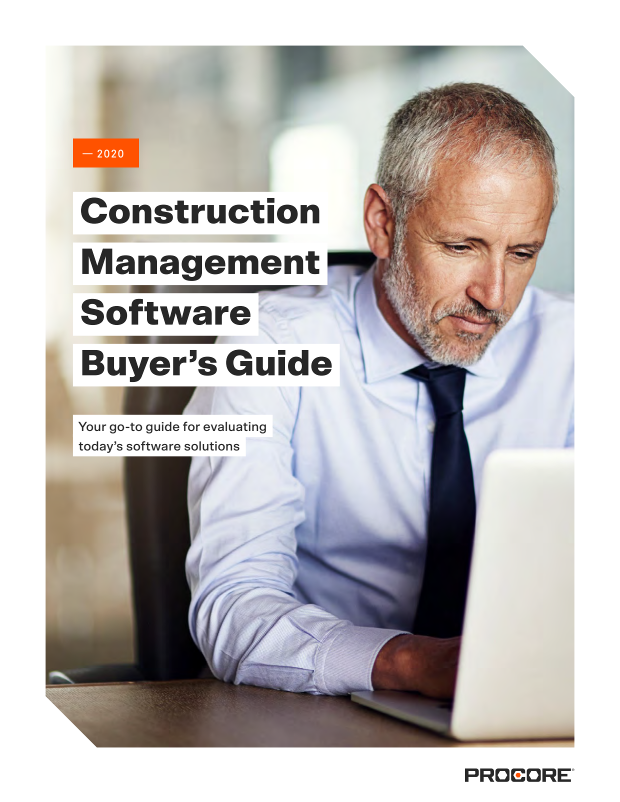
The Construction Management Software Buyer's Guide, produced by Procore, is written for the people who run that process. That includes operations leaders, project executives, IT managers and whoever got handed the evaluation. It gives you a framework for deciding what you need, comparing vendors on equal terms and making the case to leadership.
How to evaluate construction management software before you talk to vendors
Many software purchases go wrong before the first demo. Teams start shopping without agreeing on the problem, so the flashiest product wins. The guide starts earlier. It shows you how to define your pain points, turn broad goals into measurable objectives and build a weighted set of vendor criteria. It also covers who belongs on a tech buying committee and why bringing in field staff, IT and executives early saves trouble later.
You'll also find advice on securing executive support up front, so your research has backing before you spend weeks on it.
Platform vs. point solution, licensing and the other questions that shape cost
Once you start comparing products, the feature list is only part of the story. The guide explains the architectural and commercial choices that decide how a system will work for you over the years, including:
- The trade-offs between a construction platform and a collection of point solutions
- What open APIs and integrations mean for your accounting and office systems
- How three common construction software licensing models affect who can reach project data, and what you actually pay
- What to expect from mobile apps and offline access on jobsites without reliable WiFi
- Reporting and analytics across project management, financials, and quality and safety
- Security, compliance and data ownership terms to raise with any SaaS provider
Each topic is framed around questions you can put to a vendor, so you can separate sales claims from what the software will do on a live project.
Choosing a partner, not only a product
A good demo proves little about what happens after you sign. The second half of the guide turns to construction software vendor selection beyond features. It looks at ease of use and time to value, implementation and ongoing training, technical support for every user, scalability and product development. It also explains how to run reference calls that tell you something useful.
You'll see how to frame software as an investment rather than an IT expense, which matters when you're asked to justify the budget. Pricing varies widely between vendors, and the guide points out what to confirm so your quotes compare like with like.
Working tools to keep your evaluation on track
This is a working document, not a market overview. It opens with industry research on how construction technology adoption has shifted, then moves quickly to guidance you can apply. Alongside it, Procore offers a companion workbook for recording findings as you compare vendors, plus a ready-made business case presentation you can adapt. Use it first to get approval for the search, and later to present your chosen partner.
Some readers will treat it as a checklist for a purchase that's already underway. Others will use it to slow down a decision that's moving too fast. In both cases it helps you avoid the costly outcome the guide warns about, which is a long implementation of the wrong system followed by starting the search over.
Get the full buyer's guide and planning tools
Download the PDF to get the complete framework. You'll learn how to set objectives and vendor criteria, what to ask about platforms, licensing, mobility and security, and how to judge a vendor's support and long-term fit. You'll come away with a clear process for choosing software your teams will actually use.