
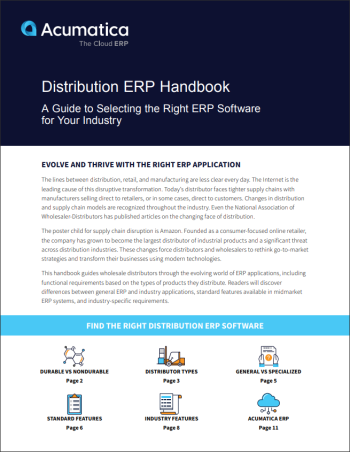
Choosing distribution ERP software as supply chains tighten
Wholesale distributors are being squeezed from several directions at once. Manufacturers now sell direct to retailers and sometimes straight to end customers. Amazon, which started as a consumer retailer, has become a serious competitor in industrial products. Your B2B buyers expect shorter lead times, painless returns and online self-service. Margins are thin, so competing on price alone isn't an option, and the system you run the business on carries more weight than ever. The Ultimate Distribution ERP Handbook, published by Acumatica, helps distributors work out what their ERP software actually needs to do before they choose a vendor.
It's written for owners, operations leaders and IT teams at distribution companies who are outgrowing entry-level accounting tools, replacing an aging industry system, or simply trying to separate real capability from marketing claims.
What the Acumatica distribution ERP handbook helps you decide
The starting point is your products. Durable goods and nondurable goods create very different demands on a system, from serial and lot traceability to expiration dates, quality rules and regulatory compliance. The handbook shows how those product characteristics translate into software requirements, so you can stop evaluating features in the abstract.
From there it looks at how you sell. It profiles six distribution business models, including general distribution, wholesale, retail and commerce, direct to consumer and direct store delivery, and outlines the ERP capabilities each one tends to rely on. If your company blends several models, you'll find it easier to see where your requirements overlap and where they don't.
One of the most practical sections tackles a choice many distributors struggle with: a specialized industry ERP built for a niche, or a general midmarket system. The handbook compares the two side by side on technology, accounting depth, distribution functionality, customization and the consulting and support options available to you. It also explains why smaller distributors often start on basic accounting software with add-ons, and what changes as they grow.
You'll also get a grounded view of the standard features found across midmarket distribution ERP, covering platform and tools, accounting, sales, inventory and warehouse management, purchasing, and commerce and point of sale. The useful part is the emphasis on how these features differ in practice. Two systems can list the same module and still handle it in very different ways, and the handbook points out where to look closely, including the gap between applications built for the cloud and older software moved to it.
What you'll be able to do after reading
- Match ERP requirements to the products you distribute and the way you sell them
- Weigh an industry-specific system against a general cloud ERP with clear criteria
- Spot the differences hiding behind similar-looking feature lists
- Build a sharper set of questions for vendor demos and evaluations
Industry-specific ERP requirements, from chemicals to fashion
Generic advice only goes so far when you sell pharmaceuticals or petroleum. The handbook breaks down requirements for more than 15 distribution segments, including chemicals and coatings, grocery and alcohol, industrial and MRO supplies, hardware and HVACR, fashion and apparel, technology products, and lumber and building materials. Each profile highlights the capabilities that matter most in that sector, such as handling product variations, picking by expiration date, tracking by lot or serial number, or running field service alongside distribution.
Throughout, you'll hear from distributors in sectors like pharmaceuticals, chemicals, craft beer, transportation and industrial supplies about what changed when they moved to Acumatica. The handbook closes with an overview of the Acumatica Distribution Edition and its cloud ERP approach, including its consumption-based licensing model, so you can see how one vendor addresses the requirements discussed earlier.
Get the free distribution ERP handbook
Download the full handbook to get the product-type comparison, the requirements for each distribution model, the side-by-side look at industry and general ERP, the breakdown of standard features and where systems differ, and the detailed profiles for more than 15 industries. It's a practical reference to keep open during your next ERP evaluation, and it will help you walk into vendor conversations knowing exactly what to ask.