

Business Central vs Sage Intacct: choosing the right mid-market ERP
When a growing company outgrows its accounting software, the shortlist often narrows to two cloud platforms. On a feature grid, the Business Central vs Sage Intacct decision can look close, since both handle core financials well. The real differences appear later: in what you pay as you add capability, in how far the system reaches beyond the finance department, and in how easily you can change direction once you're live.
Most mid-market companies replace their ERP rarely, so a poor fit stays with you for years. Pick strong financial management software that can't support inventory or manufacturing when operations demand it, and you end up bolting on third-party tools. Pick a broad platform when your needs are finance-led, and you may pay for reach you never use. Both are costly mistakes to unwind.
What this cloud ERP comparison covers
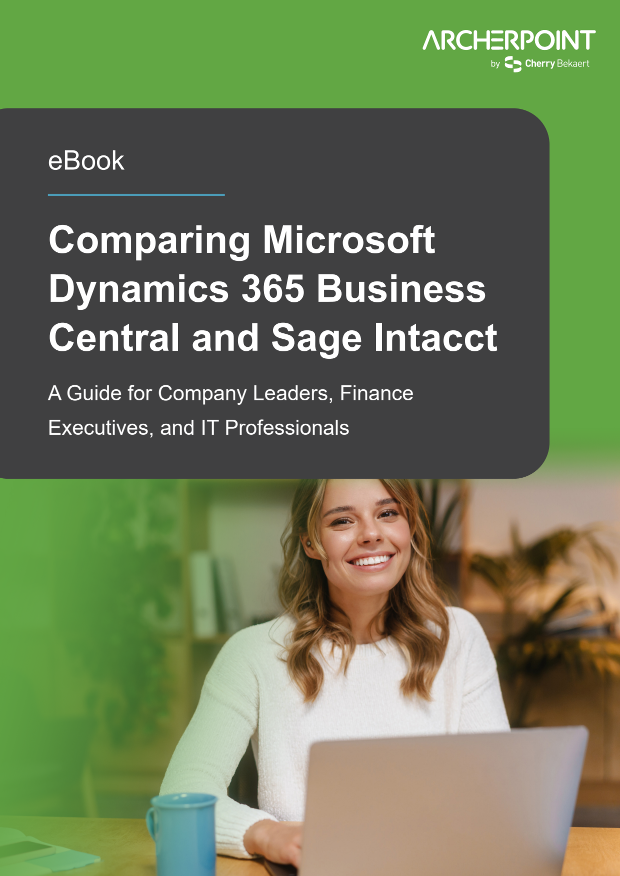
Written for company leaders, finance executives and IT professionals, the eBook puts Microsoft Dynamics 365 Business Central and Sage Intacct side by side across eight areas that shape long-term value. Each section explains how the two products approach the issue, then closes with a short, plain-language verdict you can bring straight into a selection meeting.
- How each licensing model behaves as your requirements expand, and where costs tend to climb
- Cloud and on-premises deployment, and why the choice matters for compliance, data sovereignty and IT policy
- Customization and extensibility, from low-code tools and APIs to developer options and app marketplaces
- The Copilot AI capabilities in each product, and how far each vendor's AI reaches beyond finance
- Reporting built for the finance team compared with reporting that spans the whole operation
- Partner ecosystems, vendor support, and what's involved in switching implementation partners
- Scalability for multi-entity, multi-currency and operational growth
- Security, identity management and compliance credentials
You'll come away understanding how the scope and architecture of each platform differ, not just which features appear on a datasheet. That distinction matters most for companies whose plans include adding distribution, manufacturing, projects or new entities over the next few years.
Questions to put to both vendors before you sign
One of the most practical parts of the eBook is a set of six questions your leadership team should ask both providers. They cover areas such as how predictable your costs will be as transaction volume grows and what limitations apply to multinational companies with data residency requirements. The aim is to surface hidden costs and constraints that rarely come up in a polished product demo.
The eBook finishes with a clear decision framework that matches each platform to a distinct set of strategic priorities. Rather than declaring one product better in every case, it helps you recognize which profile describes your organization, so the choice rests on your own goals instead of a sales pitch.
Practical ERP selection guidance from ArcherPoint by Cherry Bekaert
The eBook was produced by ArcherPoint by Cherry Bekaert, a firm with decades of experience helping companies select and implement ERP systems. That background shows in the focus on the questions buyers actually face after go-live: whether costs stay predictable, whether the partner relationship can change, and whether the system can keep pace with the business.
It's a short, focused read. Finance leaders will see how each platform handles consolidation, reporting and compliance. IT teams will find the material on deployment, extensibility, integration and security. Executives get a fair framing of the trade-offs that will affect long-term value. Because everyone works from the same comparison, it's also a useful document to circulate before a vendor shortlist meeting, so finance and IT start from shared facts rather than separate assumptions.
If you're building a business case for a new system, the side-by-side structure makes it easier to explain why one platform suits your plans. And if you've already seen demos from both vendors, the comparison can help you spot what those demos left out.
Download the Business Central and Sage Intacct comparison
Get the full eBook to see the detailed side-by-side comparison across all eight areas, the verdict for each one, the complete list of questions to ask both vendors, and the framework for deciding which platform fits your priorities. Fill out the short form to download your copy and take a clearer view into your next ERP decision.